Localization challenges can delay launches, frustrate gamers, and cost studios millions. That’s why understanding how these problems crop up and how to solve them is important.
With that in mind, we want to help you understand the 10 most common game localization problems developers face in 2026—and equip you with the best practices to solve them. But, to do so effectively, we need first to set some critical definitions:
- What exactly do we mean by video game localization?
- And what game localization problems should you prepare for?
What is video game localization?
Video game localization is the adaptation of a game to suit local gamers’ preferences. While the bulk of game localization services focus on traditional translation, localization encompasses many elements (text, audio, art, etc.) that become growingly important as a game matures and expands.
For instance, when World of Warcraft was first developed, it was made with U.S. gamers in mind. But as the game grew and expanded into new markets, they had to adapt it for French, German, and Chinese gamers.
And we aren’t just talking about translating the game quests. But rather, many elements, both in-game and out:
- Text (menus, quests, items, etc.).
- Audio (dialogues, sound effects, etc.).
- Gameplay (more fast-paced, more community, etc.).
- Art (visual modifications to fit local preferences, market the game better or fits local regulations, etc.).
- Pricing (Vietnamese gamers can’t pay the same prices as American gamers).
- Legal requirements (age ratings, content regulations, data privacy, etc.).
That’s a lot, we know. But we promise each element is essential.
A non-localized game can’t grow. And a poorly localized game gets aggressively punished by its community. And you don’t have to take our word for it. The case below is well worth the read.
Why does video game localization matter in 2026?
The short answer? Because gamers care about it. Gamers are passionate and have high expectations from their games. That is especially true in today’s hyper-competitive landscape.
They want to interact with their favorite games in their native language. If you don’t take the time to localize your game, gamers will play another one instead. And the data backs this up.
According to NewZoo, the global video game market reached $197 billion in consumer revenue in 2025. That’s a massive pie. But here’s the thing—most of it isn’t English-speaking.
According to Steam’s Hardware & Software Survey (January 2026), only 37% of Steam users have English as their UI language. Simplified Chinese sits at nearly 24%, Russian at 10%. Nearly two-thirds of Steam’s audience uses a language other than English.
Steam Hardware & Software Survey — January 2026
Language Distribution on Steam
And localization pays off directly.
According to the Taipei Times, a study of over 10,000 games across 70+ countries found that localized games saw up to +12.1% higher sales revenue in those markets, with a potential increase of 17.83% in total sales.
Not convinced? Consider what happens when you get it wrong.

The text in each of these reviews roughly translates to: “I do NOT recommend this game since they did not bother adding Spanish subtitles.”
And that’s just one review.
Hollow Knight: Silksong launched with a poor Chinese localization and paid dearly for it. Only 42% of nearly 20,000 Chinese-language Steam reviews were positive, with over 14,000 negative reviews specifically citing the translation. Team Cherry had to publicly promise improvements.
As we said, even in 2026, it remains vital to think of localization during the game development process. It can pay dividends later on.
Case in point.


10 video game localization challenges every developer faces
1. Quotes
A quote is a statement expressed by another person and is included in a text verbatim. Quotes can come from books, poems, speeches, etc.
In a game, a quote can come in many forms. For instance, non-player characters (NPC) can talk with players using quotes as a code to deliver vital information.
When dealing with a quote, cultural references and contextual understanding are very important. A translator can’t focus solely on providing an accurate translation. They have to go beyond that and think of the quote’s full meaning.
Literal translations can create entirely different meanings. Consider this Chinese quote:
“情人眼里出西施.”
“Qing ren yan li chu xi shi.”
Its literal translation “In the eyes of loved ones, Xi Shi appears,” is meaningless.
A better translation would be, “Our loved ones are always more beautiful than others.” Although it strays from the literal interpretation of the source text, it captures its intended meaning.
The thing is, Xi Shi is a Chinese historical figure who represents love. But, as famous as she is in China, Xi Shi is unlikely to provoke a reaction among non-Chinese audiences.
This kind of challenge shows up in gaming all the time. Take Dark Souls. Solaire’s famous line, “The flow of time itself is convoluted.” It was translated from a Japanese concept closer to time “stagnating” (淀む).
The English word “convoluted” implies tangled timelines. But the Japanese original evokes a river backing up and pooling—a fundamentally different metaphorical frame. Item flavor text across the game reinforces the “stagnation” reading in Japanese. It’s not a bad translation per se, but it shifted how Western players interpreted the entire lore.
Or consider Final Fantasy IV’s legendary line, “You spoony bard!” As documented by Legends of Localization, this line doesn’t exist in the original Japanese scene at all. The translator invented it. And it became one of gaming’s most enduring memes.
That’s why teams dealing with quotes often rely on cultural consultants and localization glossaries. Understanding the source text is only half the job. Knowing how it will land in the target culture is the other half.
2. Slang
Among the top video game localization challenges, slang is one of the trickiest. Every language has its own and it’s typically new and ever-changing.
It rarely, if ever, has a direct counterpart in other languages. The meaning of each term can be subtle and quirky, and a few years later, it may come to mean something different.
In live-service games, this localization problem is even worse. Player communities constantly generate new slang, and it evolves faster than most translation workflows can keep up.
To make matters worse, this vernacular varies from one gaming subculture to another, typically born to desribe each genre’s unique mechanics, characters and archetypes. That’s why game localization issues can be tricky to iron out.
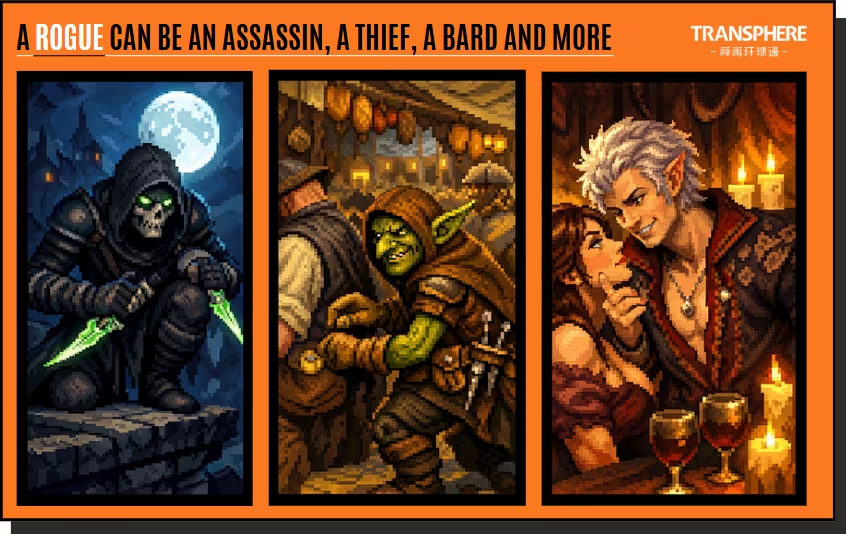
Let’s look at a quick example: the rogue.
This word is a common character type that any RPG fan can instinctively understand. But if a translator with no RPG or gaming experience were to translate it, they would stumble. Let’s look at what they might find in an online dictionary.

None of the above translations would fit. In a game, a rogue typically refers to a class or a profession, not a personality trait.
Another great example is the MOBA genre. If you’re not familiar with it, this category includes hyper-popular games like DOTA or League of Legends. In this genre, the following terms are prevalent:
- Gank.
- Carry.
- Tank.
- Lane.
- Push.
As you can imagine, “tank” does not refer to a military vehicle. Instead, it refers to a specific character archetype whose role is to protect its teammates and soak up plenty of damage. A tank’s defining characteristic is its durability (and sometimes its crowd control).
“Push” does not mean the act of pushing another character away, far from it. Instead, it means a team’s systematic and coordinated attempt to attack specific enemy objectives.

As you can see, if a translator only looks at the source text, they will fail. Translators must play the game in both languages to have the necessary knowledge to succeed.
On top of that, slang can carry cultural and legal weight. References to alcohol or gambling may not be allowed in some countries, even if they are an inherent part of your game’s lingo. We’ll cover the legal aspects of localization in more detail later.
3. Coding
Coding mistakes during localization can cause real in-game issues. For example, if your gaming journey was interrupted by symbols like these:
“���”
Then, it means there is no encoded match in the target text for the characters from the source text, which is a UTF-8 encoding issue (the standard that allows games to support multiple character sets).
When the encoding doesn’t match, you get garbled text instead of readable characters.
A similar error can happen with fonts. Sometimes, a font’s design is too exaggerated or artistic. And it doesn’t have a match in the target language. In this situation, gamers may see these symbols “□□□” on the screen.
Chinese and Arabic are good examples. Their scripts provide lower degrees of freedom than Latin fonts.
But encoding isn’t the only localization issue in the code. Two other common problems deserve your attention.
The first is hardcoded strings. That’s when text is embedded directly in the source code rather than placed in external, translatable resource files. It’s one of the most common and most preventable coding mistakes in localization. If a string is hardcoded, your translators can’t even access it.
The second is string concatenation (assembling sentences from fragments in the code). For example, a developer might build a sentence by combining `”Warp to “` and `”Member”` as separate pieces. That works fine in English. But in languages with different grammar and word order, it creates nonsense.
EVE Online ran into this exact problem. Before the Crucible expansion, CCP developers reused existing UI strings like “Warp to” and “Member” and concatenated them programmatically, without considering how the combined result would translate. The result was mistranslations and broken sentences in localized versions.
CCP later instituted a rule: UI text is never allowed to be concatenated. And their QA tools now flag it automatically.
4. Placeholders
Placeholders are short codes inserted into sentences that will be replaced by in-game text; for example, “%s,” “%1$@.”
These placeholders should become actual, real values in-game, not just symbols. These values can represent dynamic or imported values by players (e.g., name, date, figures, texts, etc).
Translators should never delete or alter placeholders during localization. Otherwise, the changes will create in-game bugs. For example, a common way to reward a gamer is to give them gold coins after a quest. In this context, a placeholder could appear as “you get %s GOLD.”
But your gamer will never receive their reward if the placeholder gets deleted. And as you well know, a broken quest leads to angry gamers.
Translators must be very careful. Not only are placeholders critical, they are easy to mess up. They tend to come in text form. So, accidentally deleting them is easy.
But there’s a subtler problem that many developers overlook: grammar.
Placeholders create major issues in gendered and inflected languages. A string like “%s picked up the %s” works perfectly in English. But in French or German, articles and adjective endings must agree with the noun’s gender. If the placeholder gets replaced by a masculine noun in one instance and a feminine noun in another, the surrounding grammar breaks.
And it gets more complex. English has simple singular/plural rules. But Arabic has a dual form, and Polish has complex plural categories. A placeholder like “%d items” needs entirely different handling per language. One template does not fit all.
5. Format issues
During the localization process, format issues are common due to the varying lengths of different languages. While these differences may seem minor, they become inherently problematic when dealing with limited space (e.g., game menus).
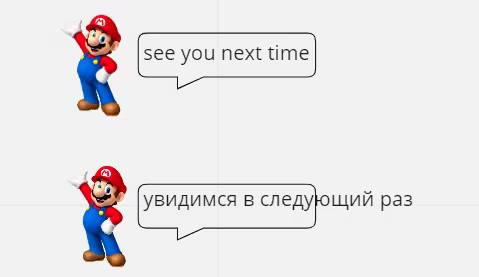
The picture above illustrates the differences between English and Russian script. As you can see, when you translate “See you next time” from English to Russian, the Cyrillic script is too long for the text box.
Another common issue is with Asian languages. Chinese and Japanese don’t use spaces between words, so the game engine’s line-breaking logic must handle these languages differently. And some games auto-shrink text to fit containers, which can make localized text unreadable at small sizes—especially on mobile.
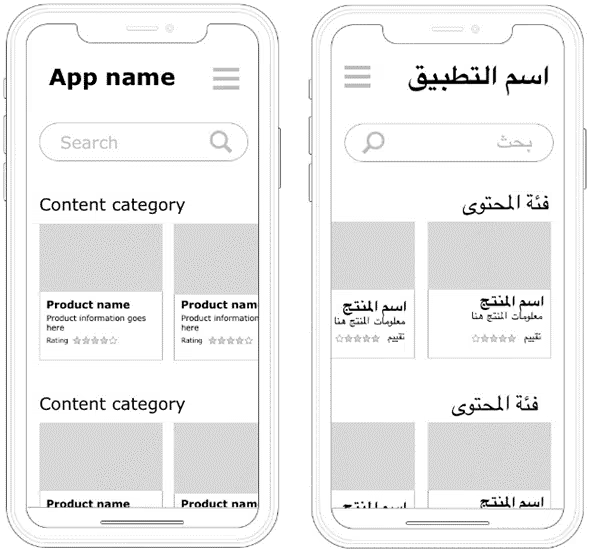
Length aside, some languages (e.g., Arabic or Hebrew) are written from right to left (RTL) rather than left to right (LTR), which can really exacerbate format issues. If you are unaware of these differences in advance, it may require redesigning your entire UI.
6. Delayed launches
Aside from creating an astounding game, one of your most important goals is to get your game to market as soon as possible.
Every extra month you spend in the game development phase results in higher costs with no additional revenue. To make matters worse, video game localization challenges can significantly delay your game deployment.
For instance, when you update your game, each new feature should be supported in your target languages. It’s not a big deal with small patches, but what about a significant expansion?
Consider Lightning Returns: Final Fantasy XIII. Square Enix explicitly delayed the overseas release to be “more thorough” with localization. Japan launched in November 2013; North America didn’t get the game until February 2014 (roughly three months later).
In today’s market, gamers expect sim-ship (simultaneous worldwide shipping). A delayed regional launch is a competitive disadvantage.
Indie developers are usually hit the hardest. They often lack the budget for professional localization, lack an established pipeline, and their small teams are already wearing too many hats.
7. Target segment
While marketing and localization are not usually part of the same process, they inform each other. And that’s for simple reasons.
First, if your localizers don’t understand your target audience (how they talk, what tone they expect, whether they prefer formal or casual language), the translation will feel off.
A game marketed to teens needs a completely different linguistic register than one aimed at strategy enthusiasts in their 30s. There’s always more than one way to translate a sentence. The right choice depends on who’s reading it.
Second, not every language is worth the investment. Localizing into a market where your genre doesn’t resonate is burning budget for negligible returns.
So how do you decide where to localize?
Start with the global landscape. According to Newzoo, there are 3.42 billion gamers worldwide. But they’re not evenly distributed:
- The Asia-Pacific dominates with 53% of all players (1.81 billion).
- The Middle East & Africa accounts for 16%.
- Europe 13%.
- Latin America 11%.
- North America is just 7%.
As we saw earlier, Steam’s language data tells a similar story. If you’re shipping English-only, you’re leaving two-thirds of the market untouched.
Note: It’s important to keep in mind that purchasing power is arguably more important. That’s why English remains the most lucrative language.
Newzoo, 2024
Global Gamer Distribution by Region
So, what’s the safe play?
Major languages. Translate into English, Simplified Chinese, Japanese, Korean, French, Spanish, Russian, and German, and you cover the vast majority of the global gaming population. These are established markets with proven purchasing power.
If (and only if) you’ve already handled the core languages, can you then consider emerging markets.
For instance, Southeast Asia continues to show strong year-over-year growth, and India is rapidly ascending as a gaming powerhouse. These regions are less saturated, which means less competition. But they come with more game localization issues and, in some cases, a lower average revenue per user.
A note on Arabic: While it is a language dear to the author’s heart, and increasingly worth investing in, it is a complex language that tends to drive game localization costs upwards. That’s primarily due to its RTL nature and complex grammatical structure. That’s the main reason it is not part of the major languages above.
Before committing to a budget, answer these questions:
- Does your genre resonate in that market? Simulation games over-index in Germany. Visual novels perform well in Japan. Battle royales crush it in Southeast Asia. Check regional sales data for games similar to yours.
- What’s your revenue threshold? If a market won’t generate enough sales to cover localization costs plus platform fees, skip it—at least in your first release wave.
- How localization-heavy is your game? A text-light puzzle game is cheap to localize. A narrative RPG with full voice acting is exponentially more expensive. Factor that into your market selection.
The bottom line is that localization is an investment. Treat it like one. Research your markets, understand your audience, and localize where the data (not assumptions) points you.
8. Voice acting and audio localization
Voice acting is one of the most expensive and logistically demanding parts of game localization. And it’s one that players immediately notice, for better or worse.
The challenges start with casting. Finding voice actors who match the original character’s tone, age, and personality in another language is not easy. A grizzled warrior in English needs to sound equally grizzled in Japanese. A sarcastic teenager in Korean needs to be just as snarky in Spanish.
Then there’s the lip-sync problem. Dubbed dialogue must fit existing character animations. Japanese lines tend to be shorter than their English equivalents. German lines tend to run longer. When the audio and the mouth movements don’t match, immersion breaks.
Emotional delivery adds another layer. How emotions are expressed vocally varies across cultures. What sounds dramatic in English may sound melodramatic in Japanese, or flat in French. Voice directors need to understand these nuances for each target language.
And let’s not underestimate the sheer volume. Modern RPGs can contain tens of thousands of voiced lines. Re-recording all of them in multiple languages is a massive logistical and financial undertaking.
But when you get it right, players reward you. Take Far Away and its Cantonese dubbing. Steam reviews overflowed with positive feedback from players thrilled to hear high-quality voice acting in their native language. It’s a clear reminder that voice localization issues matter to gamers—a lot.

On the cost side, AI voice synthesis tools (like ElevenLabs) are emerging as an option for dubbing minor characters and ambient dialogue (the hundreds of NPC barks and background chatter that would otherwise go unvoiced in localized versions).
This isn’t about replacing human actors for protagonist roles. It’s about making full voice localization financially viable for studios that otherwise couldn’t afford it. That said, the industry is still debating the ethics of AI-generated voice, and most major studios use it as a supplement, not a replacement.
9. Lack of context
This one might be the most underestimated game localization problem out there. And yet, it underpins many of the challenges we’ve already discussed, from quotes to slang to placeholders.
Here’s the problem.
Translators often receive spreadsheets of decontextualized strings. Just rows of text with no indication of who says them, when they appear, or where they show up on screen. And yet, they are expected to translate accurately.
Consider a string like “Fire.” Is it a fire spell? A command to fire a weapon? A termination (“You’re fired”)? Or a literal fire?
Without context, the translator has to guess. And guessing is how localization mistakes happen.

The issue gets worse in gendered languages. In French, Spanish, or German, the adjective form, or even the word for “you,” changes depending on the speaker’s and the listener’s gender.
If the translator doesn’t know who’s speaking to whom, they can’t translate correctly. A male character greeting a female character requires different grammar than two male characters talking to each other. But in a spreadsheet, you only see the words.
The good news? There are practical solutions. Localization kits that include screenshots, character descriptions, and scene context can make a huge difference. Style guides that explain character voices and tone help translators maintain consistency. And in-context review tools (where translators can see their work inside the actual game) catch mistakes that spreadsheets hide.
10. Legal and regulatory compliance
Unlike previous game localization challenges, this one can block your launch entirely.
Every country has its own rules about what’s acceptable in a video game. And we’re not talking about small differences. What’s perfectly fine in one market can be illegal in another.
Let’s start with age rating systems. ESRB (US), PEGI (Europe), CERO (Japan), and others all have different standards. Content that passes under one system may require changes for another. And these aren’t just recommendations. In many countries, you can’t sell your game without the appropriate rating.
Then there’s content censorship, which goes well beyond translation. It requires actual asset changes.
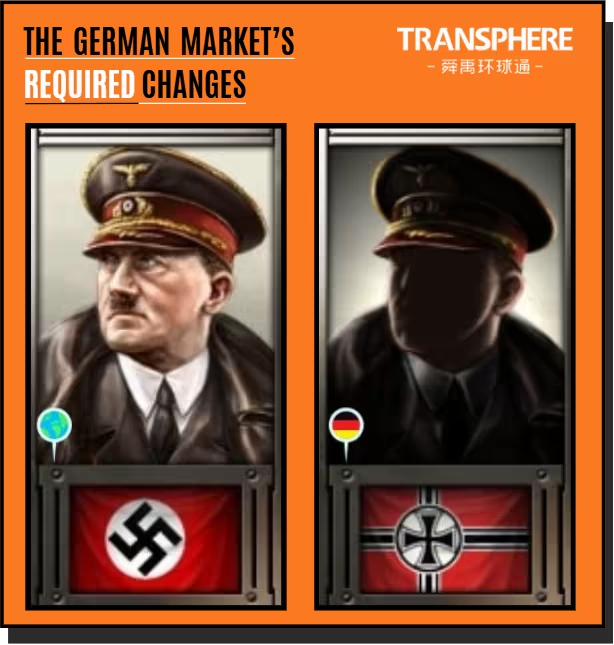
Take Hearts of Iron. The strategy game features historical Nazi commanders and imagery. For the German market, all of it has to be altered or removed.
Germany historically restricted depictions of Nazi symbols in games, and while the laws have relaxed somewhat, developers still tread carefully. Wolfenstein faced similar localization issues with its depiction of Hitler.
China has its own set of rules. In World of Warcraft: Wrath of the Lich King, bones, skulls, and gore had to be visually replaced for the Chinese version. Skeletons were turned into other models, and exposed bones were covered with flesh. Same game, completely different art.
On top of visual censorship, there are monetization laws to consider. Belgium banned loot boxes outright. Other countries require probability disclosures for randomized purchases. Localization teams need to work with legal to adapt in-game stores for each market.
And let’s not forget data privacy. GDPR (EU), COPPA (US), and regional equivalents affect how games collect player data. This touches in-game forms, account creation screens, and consent language.
Best practices for solving game localization problems
1. Brevity
If there is such a thing as a simple heuristic to keep in mind during localization, it’s probably to keep it simple.
As you know, the UI of any given game is limited. That is especially true for mobile games, where screen real estate is at its smallest. As such, you should limit the size and length of your content.
For translators, complicated content can make it difficult to fit into text boxes. It may also negatively impact the user experience. Think about it: when someone is playing a game, they need to process a lot of information. Dozens of real-time interactions, from fights to dialogues and everything in between.
If the content is excessive, gamers may feel overloaded and will only digest some of the information in your game. At best, they may start skipping dialogues, and at worst, they may give up on your video game. Keeping your content short can help players stay engaged and digest the game smoothly.
2. Transcreation
We’ve touched on this before, but you can solve many video game localization challenges by transcreating. This is how you tackle the quote and slang challenges we discussed earlier.
The vocabulary used in video games is very unique. It rarely has a direct translation. Transcreation can express your characters’ tone, emotions, and cultural backgrounds. It can paint a picture that a literal translation cannot fully capture.
Consider the many in-game elements you need to translate (characters, weapons, skills, upgrades, regions, cities, etc.). Relying on more than plain translation is the smart choice.
For example, say you have a character called “Powerful Titan.” A direct translation into Chinese would be 强大的泰坦 (Qiángdà de Tàitǎn). Technically accurate—but it reads like a literal English-to-Chinese dictionary conversion. “
泰坦” (Tàitǎn) is just a phonetic transliteration of “Titan,” a concept borrowed from Greek mythology that has no cultural resonance in China. The result feels foreign and clunky, like watching a dubbed movie where the lip-sync is slightly off.
Instead, you transcreate. Pick an original name rooted in Chinese mythology that captures the character’s essence—raw power and imposing strength. Chinese folklore is rich with figures that fit this archetype perfectly. The localized name won’t be a direct translation, but it will feel right to Chinese players. It will resonate culturally in a way that “强大的泰坦” never could.

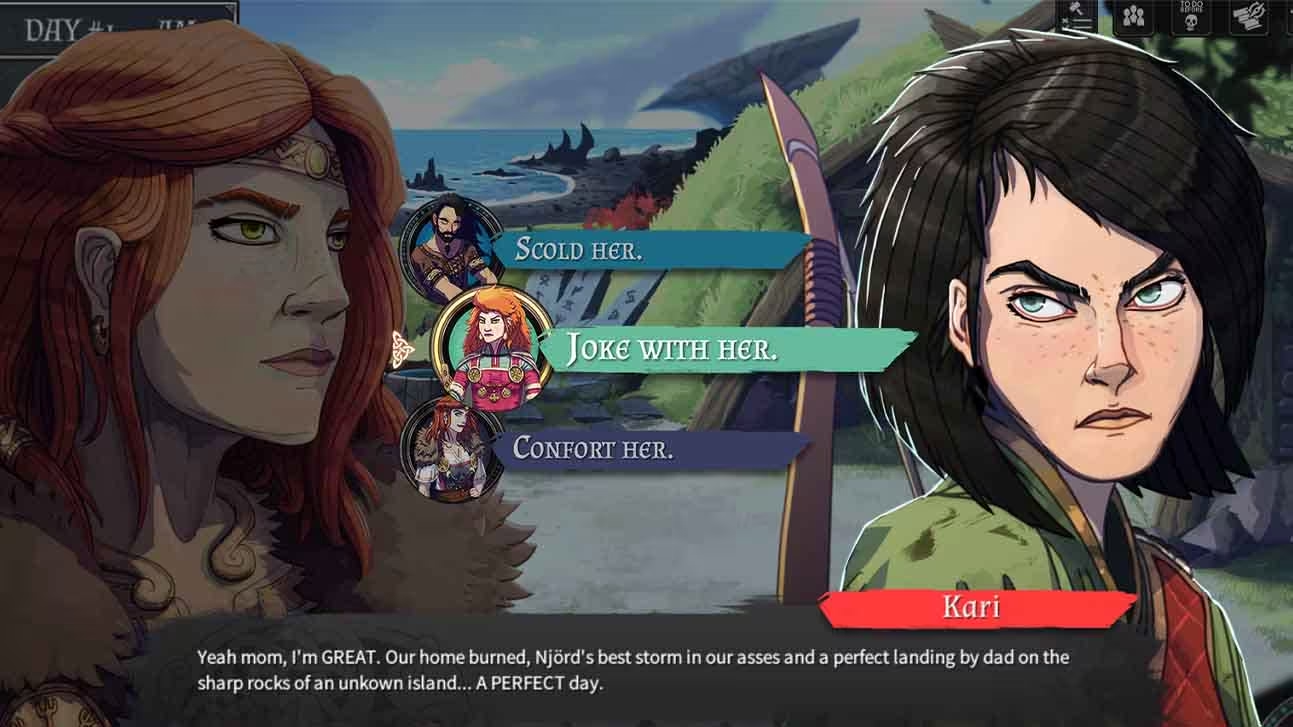
Here’s a subtler example. In Dead in Vinland’s Latin American Spanish localization, translators had to decide how to translate a Viking character’s (Kari’s) reference to her father. The options came down to “de papa” (formal “father’s”) or “el viejo” (colloquial, irreverent “the old man”).
Since Kari talks like an irritated teen, “el viejo” was the clear winner. “De papa” would have flattened her personality entirely. That’s transcreation in action: adapting tone and style to fit your characters’ personalities, not just the strings.
If you intend to rely on gaming localization services, hire a team that can transcreate. The localizers can fully transfer your character’s charisma by recreating your content in your target language.
3. Become a gamer
At the end of the day, to create a truly unique product that your customers will love, you have to understand them deeply. By becoming a gamer, you can actually go through the experience your customers will go through.
You will experience their way of communicating, what they enjoy, and where they struggle. It is the best way to solve video game localization problems.
It’s not just about playing your own games. By engaging with the gaming community, you can understand them across the board. As a result, you’ll likely glean insights beyond localization. By combining your thoughts with feedback from other players, you can bring new inspiration to adjust your strategy.
If you rely on translators who don’t play games, they may translate your game very well, but the translated text will lack a gamer’s touch. It will read like a novel or a movie. But a game is not a novel or a movie. It has its own vocabulary.
That’s why many studios now hire LQA (Linguistic Quality Assurance) testers (professionals who are both gamers and linguists). They catch the issues that pure translators miss.
A truly immersive game must be designed, developed, and localized by gamers.
Modern tools to overcome game localization challenges
Traditional translation tools
Game localization relies on a layered toolstack. At the top is the Translation Management System (TMS), below that sits the CAT tool (Computer-Assisted Translation), where translators do the actual work. The CAT tool pulls from two foundational components: Translation Memory (TM), which stores previously translated segments for reuse, and Machine Translation (MT) engines.
For developers, the analogy is straightforward: TMS is your CI/CD pipeline, the CAT tool is your IDE, TM is your package repository, and MT is your code autocomplete. More or less.
The value of these tools is quite clear: a steep reduction in game localization costs (up to 70%).
Continuous localization
Nowadays, developers update their games regularly and need them localized immediately. But by relying on traditional gaming localization services, the process is too slow. Developers, translators, and project managers work sequentially.
In other words, this old process forces you to work in big batches. Or at least slow batches. Localizers wait for the developers to complete a whole patch before they start working. Here is what the process looks like:

This process needs to take place for every batch of new code. Of course, if there are any issues along the way, you must start from step 1, which wastes a lot of time.
But continuous localization allows you to integrate localization with game development. The two teams can work in parallel, saving you a whole step.
Continuous localization enables gaming localization companies to use their resources more effectively. It creates a more efficient process that bypasses delays and increases flexibility.
This matters especially for live-service games like Fortnite or Genshin Impact, where new content drops regularly, and localization must keep pace with agile development cycles.

Generative AI in game localization
Generative AI is reshaping game localization in ways not seen since the advent of machine translation itself. According to the GDC State of the Game Industry survey (2025), 52% of developers work at companies that have implemented generative AI, and 36% personally use it.
According to Reuters, that number is even higher! They report that 87%of video game developers are now using AI agents to automate or streamline tasks. This isn’t incremental improvement. It’s a paradigm shift.
NOTE: It’s important to internalize that the above survey is from August 2025. That was when the best agent (if we can call it one) available via Claude Code was Opus 4.1, and Manus was the closest scaffolding to a functional agent.
As of the February 2026, Claude Code is substantially more advanced, relying on Opus 4.6, and agentic workflows are becoming more widespread (Kimi 2.5 Agent Swarms, etc.). As such, the above numbers are unlikely to remain at those levels.
The impact spans two major areas:
Large language models now generate contextually aware first-pass translations that understand gaming terminology, character voice, and tonal nuance far better than traditional MT engines.
Automatic Post-Editing (APE) refines raw machine translation output before it even reaches human reviewers, catching obvious errors and improving consistency. Machine Translation Quality Estimation (MTQE) automates the triage process, flagging which segments require human attention and which are ready to ship.
As a result, linguists spend their time on creative problem-solving (transcreation, cultural adaptation) rather than fixing grammatical errors.
AI voice synthesis tools like ElevenLabs can generate localized voice lines for minor NPCs and ambient dialogue at a fraction of the cost of traditional recording.
Beyond audio, tools like Nano Banana 2 and multimodal LLMs are being used to modify visual assets for localized markets. They can speed up modifications, from simple background to drafting assets.
But, as usual with Generative AI, precision is where it flails most. Whether in audio, text, or graphic design, a professional is still required to ensure the final output meets your standards.
To put the adoption curve in perspective: 1 in 5 Steam games released in 2025 used generative AI. That’s a 681% year-on-year increase. The tools are here. The question isn’t whether to adopt them. It’s whether your team is using them effectively yet.
Key takeaways for overcoming video game localization challenges
- Traditional tools (TMS, CAT, TM, MT) deliver efficiency and cost cuts, but in 2026, they’re baseline infrastructure. Generative AI is the paradigm shift, transforming translation workflows, asset modification, and workflow optimization at a scale not seen since MT itself.
- For linguistic challenges (quotes, slang, context deprivation), translators need brevity, creativity, and cultural understanding. Context is everything. Give translators screenshots, character descriptions, and scene context to prevent the most common localization problems.
- Transcreation matters. Word-for-word translation isn’t enough. Adapting tone, register, and cultural references (like replacing “Powerful Titan” with 刑天) is what makes localization feel native, not imported.
- Market selection is a strategic decision, not a checklist. Use data (not assumptions) to decide where to localize. Understand your genre’s regional performance, your revenue threshold, and whether you’re targeting established markets or emerging growth regions.
- Legal compliance is a high-stakes challenge that can block your launch entirely. Plan early, budget accordingly, and understand regional content restrictions before you ship.
- The ultimate goal of gaming localization is to engage with the audience and create a better gamer experience. You can only truly localize a game when you understand gamers, which means playing games yourself.
- Sometimes, leaving it to video game localization professionals is the smartest move.