
Summary: Spanish game localization is one of the easier localization targets if you’re starting from English and it opens the door to an audience of about 280 million Spanish-speaking gamers worldwide.
A strong Spanish release helps developers reach a broad, mainstream player base across Spain, Mexico, Argentina, Colombia, Peru, Chile, and a sizable bilingual upside audience in the United States.
In this article, we break down how large that audience really is, what the Spanish-speaking gaming market looks like country by country, how player behavior differs across those markets, and what challenges developers should expect when localizing well.
What is Spanish?
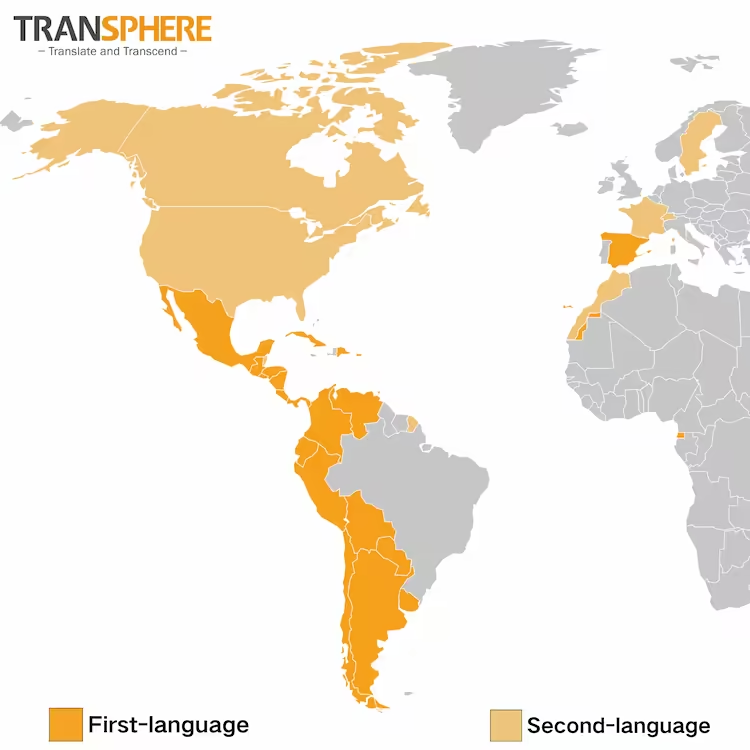
Spanish is a Romance language within the Indo-European family and one of the largest language communities in the world. Spanish is the official language of 18 sovereign states in the Americas, and it is also official in Puerto Rico, Spain, and Equatorial Guinea. Mexico remains the country with the largest Spanish-speaking population.
When discussing Spanish for game localization, it is useful to distinguish between two broad production targets:
- Castilian Spanish (Castellano): The standard variety used for releases targeting Spain, primarily in the Iberian Peninsula;
- Latin American Spanish: An umbrella label used for releases targeting Latin America, where vocabulary, tone, and preferred forms can still vary from country to country.
For game localization, developers often adopt “neutral Spanish” (español neutro) to reach the broadest possible audience. This works especially well for UI, tutorials, and store copy, but it should be treated as a practical cross-market standard rather than a single uniform dialect. Dialogue-heavy games, humor, and culturally specific references may still benefit from regional adaptation.
How many people speak Spanish?
According to Instituto Cervantes’s 2025 estimates, Spanish has about 635.7 million potential speakers worldwide. That total includes 519.1 million speakers with native command, 92.1 million speakers with limited or non-native command, and 24.6 million learners studying Spanish in educational settings.
Because these totals are revised as new census and education data become available, they are best presented as current estimates rather than fixed constants. Methodology
Spanish native speakers
Based on Instituto Cervantes’s 2025 figures, the largest populations with native command of Spanish are in Mexico, Colombia, Spain, Argentina, and the United States.
- Mexico: 130.0 million
- Colombia: 52.1 million
- Spain: 47.3 million
- Argentina: 46.9 million
- United States: 45.5 million
- Other Spanish-speaking countries: approximately 202 million combined
The United States also deserves more emphasis than it usually gets in localization discussions. Instituto Cervantes estimates 65.5 million potential Spanish speakers there in total, and its long-term projections indicate that by 2060 the U.S. could become the world’s second-largest Spanish-speaking country after Mexico.
Non-native speakers
In 2026, there are roughly 92.1 million speakers with limited or non-native command, plus 24.6 million learners in formal educational contexts.
Spanish remains one of the most widely studied foreign languages in the world, but its learner base is highly concentrated geographically. The United States, Brazil, and the European Union account for roughly four out of every five Spanish learners worldwide.
In the United States, Spanish is learned by 76% of primary and secondary foreign-language students and by 50% of university language students, underscoring its exceptional reach beyond native-speaking communities.
How many Spanish-speaking gamers are there?
A reasonable public estimate is that Spanish game localization gives developers access to up to about 285 million Spanish-speaking gamers worldwide. That number should be understood as a modeled market estimate rather than a single reported industry statistic, because no global source cleanly counts “Spanish-speaking gamers” as one category.
It is built from public player counts in the largest Spanish-speaking gaming markets, combined with Spanish-speaking population data and gaming participation rates.
Native Spanish-speaking gamers
There are about 256 million active native Spanish-speaking gamers. The core of which is concentrated in the largest markets of Mexico and Spain.
Newzoo’s 2025 country ranking estimates 78.1 million players there, making it the biggest single Spanish-speaking gaming market in the world by player base. Spain is much smaller in absolute size but still substantial, with 22.1 million players according to AEVI’s 2024 yearbook.
Argentina adds another 26 million-plus players based on recent public reporting, while Chile provides a useful benchmark for broader regional participation, with Kantar reporting that 50% of people in Chile play video games.
Taken together, those anchor markets imply a gaming participation rate of roughly 55.8% across their native-Spanish populations.
Spanish-speaking gamers outside the core Spanish-speaking markets
Beyond the core Spanish-speaking countries, there may be an additional 30 million Spanish-speaking gamers worldwide. The bulk of which resides in the United States.
In fact, according to the Instituto Cervantes, the U.S. is the home of 45.5 million people with native command of Spanish, making it the largest community from a non-Spanish-speaking country.
The Spanish-speaking market
Spanish game localization does not unlock a single monolithic market. It opens access to a portfolio of markets led by Mexico and Spain, then expanded by Argentina, Colombia, Chile, Peru, and the rest of Spanish-speaking Latin America.
Even on a conservative reading of public data, the best-documented Spanish-speaking markets already represent well over $6 billion in annual game revenue before factoring in the broader long tail or the U.S. Spanish-speaking audience.
Tier 1: Mexico and Spain
Mexico is the clearest Spanish-language anchor market by scale. According to Newzoo’s 2025 country ranking, Mexico generated about $2.7 billion in annual game revenue and had 78.1 million players, making it one of the most commercially important Spanish-speaking markets in the world.
Spain is smaller than Mexico in player count, but it remains the highest-value mature European market in the Spanish-speaking world. According to AEVI’s 2024 market figures, Spain’s games market reached €2.41 billion in 2024 and included 22.1 million players. For localization purposes, the most relevant part of that market is software and digital consumption: AEVI’s category breakdown points to roughly €1.89 billion in software, mobile, and subscription spending before hardware and accessories are included.
Tier 2 Argentina and Colombia
Argentina is the next major Spanish-speaking m:arket to prioritize after Mexico and Spain. Recent reporting from El Cronista puts the country at roughly $780 million in market revenue and more than 26 million players. That makes Argentina especially attractive as a high-reach market where Spanish localization can scale efficiently, particularly for mobile and free-to-play titles.
Colombia is smaller in revenue than Argentina, but it remains one of the region’s most important growth markets. Portafolio, citing Newzoo-based market reporting, projects the Colombian gaming market at more than $450 million in 2024, with continued annual growth through 2027. Audience estimates vary by source, but Colombia is consistently described as a commercially meaningful market rather than a peripheral one.
Tier 3: Chile and Peru
Tier 4: The long tail markets
From a publishing perspective, the hierarchy is clear. Mexico and Spain are the anchor markets. Argentina and Colombia form the next commercial tier. Chile and Peru expand reach further, especially for mobile-driven products. After that, the rest of Spanish-speaking Latin America becomes a long-tail multiplier.
In other words, Spanish localization is not just about entering one market well. It is about unlocking a cluster of markets that already represents a multi-billion-dollar revenue opportunity.
The Spanish gamer
Spanish game localization reaches several overlapping player types across Spain and the wider Spanish-speaking world. What the major markets do share is that gaming is mainstream, gender-balanced, and often mobile-led.
Where they differ is in age profile, platform mix, and how mature the market is. That makes it more useful to think in terms of player clusters than a single universal audience.
Spain
Spain should be treated as its own player profile. It’s a mature, broad, multi-platform market rather than a purely mobile-first one. AEVI reports more than 22.1 million players in Spain in 2024, with women at 50.45% and men at 49.55%.
The age distribution is also unusually broad: players aged 15–24 and 25–34 each account for 21% of the total, while the 35–44 and 45–64 brackets each account for 20%. In other words, Spanish gaming is not concentrated in just one young cohort.
Engagement in Spain is strong as well. AEVI reports 16.3 million weekly players and an average of 8.2 hours of play per week. That suggests a highly normalized entertainment market where games are part of everyday leisure across age groups, rather than a niche hobby concentrated among teenagers.
Mexico
Mexico also deserves its own subsection, but for different reasons. It is a mass-market gaming country with a younger adult center of gravity and a clearly mobile-first profile.
In the IFT’s 2024 gaming report based on Omdia consumer research, the largest age segment is 25–34 at 29.9%, followed by both 18–24 and 35–44 at 24.7%. The gender split is nearly even, with 50.6% men and 49.4% women.
Platform use in Mexico is led by mobile by a wide margin. The same IFT report shows 85.2% of gamers using mobile, compared with 51.8% on console and 49.2% on PC or laptop.
That makes Mexico the clearest example in this section of a large Spanish-speaking market where mobile should be treated as the default access point. At the same time, console and PC remain commercially meaningful.
Argentina and Colombia
Argentina and Colombia are fairly similar. Both markets are strongly mobile-led, close to gender parity, and centered on young adults rather than teenagers alone.
In Argentina’s mobile-gamer profile, women slightly outnumber men at 50.6% to 49.4%. The largest age group is 16–24 at 26.7%, followed by 25–34 at 21.9% and 35–44 at 20.6%.
Device access is broad despite the mobile focus: 99.6% report smartphone use, 81.2% PC or laptop, and 35.7% consoles.
Colombia looks very similar, though a bit older in profile. Women account for 52.2% of mobile gamers and men 47.8%. The largest age group is 25–34 at 29.4%, followed by 16–24 at 23.1% and 35–44 at 23.7%.
Device use is again led by mobile, with 99.1% on smartphones, 73.9% on PC or laptops, and 31.1% on consoles. Together, Argentina and Colombia are strong mobile-first markets with meaningful PC spillover and broad mainstream appeal.
Chile and Peru
Chile and Peru also work well as a shared profile, though not for exactly the same reason. Both are clearly mobile-first, but both also show enough cross-device behavior to matter for console and PC publishers.
In Chile, Kantar IBOPE Media reports that 55% of the population plays video games, with Gen Z participation reaching 69%. Among the devices used to play online, smartphones lead at 65%, followed by consoles at 33% and computers at 32%.
Peru’s profile is especially useful because it shows how broad device usage can be in a mobile-led market. IAB Peru reports 95% smartphone access among gamers, 92% laptop or desktop use, and roughly two-thirds with an internet-connected console.
It also finds that 41% of gamers play across console, PC, and mobile rather than sticking to a single platform. That makes Peru less of a “mobile-only” market.
The challenges of Spanish game localization
When starting from English, Spanish game localization is relatively simple compared to some challenging languages (looking at you, Arabic). That said, it has three broad challenges you need to overcome:
- Technical execution
- Linguistic choice
- Regulatory or commercial compliance.
Technical challenges
Spanish and English strings are not the same size. The former is a bit longer, leading to truncation issues. Spanish also requires full support for accents, ñ, ü, and inverted punctuation such as ¿ and ¡.
If the game is not internationalized properly, that can lead to truncated buttons, broken menus, subtitle overflow, and awkward system messages, especially when text is assembled from fragments instead of stored as complete localized strings.
When voice-over is involved, technical complexity rises again. A project may be able to share one written base across multiple Spanish-speaking markets, but audio timing, lip sync, and linguistic QA may still need market-specific review.
This becomes more important in cinematic games, tightly timed tutorials, and dialogue-heavy titles, where even small wording differences can affect pacing or performance.
Linguistic challenges
The hardest linguistic decision is usually not how to translate Spanish, but which Spanish to ship.
Microsoft’s neutral Spanish guidance explicitly notes that regional nuances, colloquialisms, and word choices can create confusion or even social embarrassment across Spanish-speaking markets.
That is why many teams use neutral Spanish for UI, tutorials, store copy, and other functional text. The trade-off is that neutral Spanish is less reliable for humor, slang, strong character voice, and culturally specific dialogue.
Formality and second-person address make this harder. Spanish can shift between tú, usted, and, in voseante markets, vos. The RAE notes that voseo is a standard form of informal address in parts of Spanish America and is especially associated with Argentina, Paraguay, and parts of Uruguay.
As a result, player-facing text needs a deliberate voice strategy: what sounds natural and friendly in one market can sound stiff or strange in another.
Spanish grammar also makes context more important than it is in English. Nouns, articles, adjectives, and many verb forms carry gender and number, which means apparently reusable English strings often stop being reusable in Spanish.
For games, that matters in account flows, avatar customization, live-service notifications, and any UI that refers directly to the player without knowing their gender or preferred form of address.
Regulatory challenges
The regulatory challenge is not that Spanish has one common rulebook. It is that Spanish spans multiple rulebooks.
In Spain, publishers are operating inside the wider EU consumer and data-protection environment. PEGI is the standard age-rating system used across 38 European countries, EU consumer law applies to digital content and services sold to consumers, and in March 2025 the EU Consumer Protection Cooperation Network published specific principles on in-game virtual currencies.
Taken together, that means age ratings, monetization design, and consumer transparency are all part of the launch conversation, especially in games aimed at younger players.
For live-service titles, child-safety and privacy add another layer. The European Commission notes that, where consent is the legal basis for processing, a child’s data requires parental or guardian consent up to a threshold set by each EU Member State between 13 and 16, and companies must make reasonable efforts to verify that consent.
In practice, that can affect account creation, age gates, analytics, social features, and parental controls in Spain and the rest of the EU.
Across Latin America, the core problem is fragmentation. Mexico has its own official video game content-classification framework, published by SEGOB in 2020.
On the other hand, Argentina still has a legacy law requiring packaged or publicly exhibited video games to carry a health warning and an age classification. That is a good reminder that Spain’s rules do not simply extend across the whole Spanish-speaking world.
Digital storefronts create an additional compliance layer on top of local law. Google Play says content ratings on the store are provided through IARC and does not allow apps without a content rating.
So Spanish localization is not just about in-game strings; it also affects store descriptions, rating questionnaires, content descriptors, and parental-facing compliance assets.
Finally, tax and payment compliance vary sharply by country. Chile’s Digital VAT regime explicitly covers providers of digital entertainment content such as games.
Peru’s Legislative Decree 1623 created a new VAT declaration and payment mechanism for digital services and downloaded intangibles. Colombia also requires VAT compliance for foreign service providers through DIAN.
None of that makes Spanish-speaking markets inaccessible, but it does mean that a “one translation, one launch” mindset usually breaks down once the commercial rollout begins.
Key takeaways
- Spanish localization can route to about 280 million Spanish-speaking gamers.
- The opportunity is led by Mexico and Spain, not by “LATAM” as one undifferentiated block. Mexico alone is estimated at $2.7B and 78.1M players, while Spain reached €2.408B and 22.1M players in 2024.
- There is no single “Spanish gamer” profile. Spain looks like a mature, broad, multi-platform market, while Mexico and much of Spanish-speaking Latin America are more mobile-led, even though console and PC still matter.
- “Neutral Spanish” works well for UI, onboarding, and store copy, but games with strong character voice, humor, or slang often need more regional sensitivity.
- The hardest part of Spanish game localization is managing variation across markets (tone, pronouns, storefront compliance, payment environments, and local regulatory differences)
