
The global gaming market generated $188.8 billion in revenue in 2025, with 3.6 billion active players spread across every continent. Yet, as of 2026, Simplified Chinese has overtaken English as the most-used language on Steam.
And surveys consistently show that over half of gamers worldwide are more likely to buy a game available in their native language. If your game only speaks English, you’re already leaving most of the market on the table.
These 10 game localization best practices (organized by development phase) will help you ship a global game rather than retrofit one.
The pre-production stage of game localization
The most important best practice for game localization is to take pre-production seriously. The decisions you make about code architecture, UI design, and market targeting before a single word is translated will determine whether localization goes smoothly or becomes a costly retrofit.
1. Internationalize your code from day one
The single most expensive localization mistake is hardcoding strings. When translatable text lives inside your source code, every language update requires a developer to dig through logic, risking bugs and bottlenecks. Instead, externalize all player-facing text into dedicated resource files (JSON, XLIFF, or XLSX) from the very first sprint.
This goes beyond dialogue. Dates, times, currencies, and number formats all vary by locale (12/03/2026 means March 12th in the US but December 3rd in most of Europe). Use a universal time format like ISO 8601 internally, and let a formatting library handle the conversion per locale. Store currency values as raw numbers with separate locale-aware display logic.
The same applies to UI graphics. If you bake text into button textures or menu images, every language requires a separate set of assets. Use dynamic text layers that pull from your external string database instead. One transparent button, one dynamic string, every language covered.
Support Unicode (UTF-8) everywhere — your game engine, your database, your export pipeline. This is non-negotiable for CJK characters, Arabic script, Cyrillic, and virtually every language outside the Latin alphabet.
2. Design your UI for text expansion and multiple scripts
English is one of the most concise languages. When you translate out of it, text expands (sometimes dramatically). English to French or Spanish typically grows by 20–25%. English to German can expand by 30–35%, largely because German creates massive compound words (the English “motor vehicle liability insurance” becomes “Kraftfahrzeug-Haftpflichtversicherung”). Short UI strings are even worse: “FAQ” becomes “Preguntas frecuentes” in Spanish—a 700% increase.
Conversely, CJK languages contract in character count but demand more vertical space and wider character rendering. Japanese and Chinese characters are visually denser and typically need larger font sizes to remain legible.
Build your UI with this in mind from the start. Design buttons, menus, and dialogue boxes with at least 30–40% extra space for text. Use responsive layouts that allow elements to resize gracefully. If you support Arabic or Hebrew, plan for right-to-left (RTL) text flow. It affects not just strings but your entire interface layout, including navigation direction and icon placement.
3. Research and prioritize your target languages
Localizing into every language simultaneously is rarely practical and almost never cost-efficient. One of the most overlooked video game localization tips is to let market data (not tradition) drive your language selection.
The industry default of “start with FIGS” (French, Italian, German, Spanish) is outdated. Look at 2024 gaming revenue by country:
- China ($48.7B).
- USA ($47.6B).
- Japan ($16.6B).
- South Korea ($7.1B).
- Germany ($6.4B).
- UK ($6.1B).
- France ($3.8B).
- Italy ($2.5B).
Japan alone generates more gaming revenue than Germany, the UK, France, and Italy combined. Recommending Italian before Japanese is leaving serious money on the table.
The right language priority depends on your platform and business model.
If you’re shipping on PC (Steam), Simplified Chinese is non-negotiable. Valve confirmed at GDC 2025 that 33.7% of Steam users have Simplified Chinese as their primary language, edging out English at 33.5%.
Steam also makes Chinese market access frictionless (no NPPA game license required, no domestic publisher partner needed). After Chinese, Japanese and Korean are high-value targets (low English proficiency, high spending). German, Russian, Brazilian Portuguese, French, and Spanish round out a strong PC set based on Steam’s user distribution.
If you’re shipping on console, Japan is critical. It’s the home market for PlayStation and Nintendo and generates $16.6B annually. South Korea, Germany, the UK, and France are all strong console markets. China is harder here: consoles were banned until 2015, market penetration remains low, and regulatory requirements are steep.
If you’re shipping on mobile, China is the world’s biggest mobile gaming market (~$37B) but access is a challenge. Google Play is banned entirely. Apple’s App Store requires an NPPA license for any game with in-app purchases. Android distribution means submitting individually to Huawei, Xiaomi, OPPO, and Vivo app stores, each with separate approval processes — and you need a domestic Chinese publishing partner. Japan and South Korea are far more accessible and have extremely high ARPU. Southeast Asian languages (Thai, Vietnamese, Indonesian) and Brazilian Portuguese are high-growth mobile markets with lower barriers to entry.
Your business model matters too. Free-to-play games that rely on network effects and microtransactions benefit from maximizing reach, prioritize high-population language groups like Chinese, Spanish, Portuguese, Arabic, and Turkish. Premium single-player games where revenue per unit matters more should prioritize high-spending markets: Japanese, Korean, German, and French gamers all have strong willingness to pay for premium titles.
In the Slay the Princess pre-release survey shared by GameDiscoverCo, only 23% of Japanese fans and 22% of Korean fans said they’d still buy the game in English only, compared to 61% of German fans and 66% of Brazilian fans. For a text-heavy game, those numbers should drive your priority list directly.
4. Choose your release model: sim-ship, post-launch, or mixed
When you release localized versions matters as much as whether you localize at all. There are three models:
- Sim-ship (simultaneous shipment) means all localized versions launch alongside the original. This is the gold standard. Game sales are heavily front-loaded, for most titles, first-week revenue accounts for roughly a third of the entire first year on platforms like Steam. If your localized versions arrive months later, you’re missing the launch window in every non-English market.
- Post-launch localization means shipping the original language first and adding translations over time. This is simpler to manage but sacrifices early sales momentum, risks negative reviews from non-English players at launch, and may result in the community creating unofficial (and uncontrolled) fan translations before yours is ready.
- The mixed model is the pragmatic middle ground most studios actually use: ship your highest-priority languages at launch and roll out additional languages post-release. This balances budget constraints against the reality that delayed localization means delayed revenue.
Sim-ship
All languages ship at launch
Post-launch
Original language first, translations later
Mixed
Priority languages at launch, rest post-release
The production stage of game localization
With the groundwork in place, the production phase is where these game localization tips translate into action. This is the stage where content actually gets adapted and where the quality of your preparation either pays off or falls apart.
5. Build a comprehensive localization kit
Translators working without context produce mediocre results. A well-prepared localization kit (or “loc kit”) dramatically improves translation quality and reduces back-and-forth.
Your loc kit should include: a glossary of approved terms (character names, items, abilities, lore-specific vocabulary), a style guide defining tone and register, character bios with personality and relationship details, a plot summary with key narrative beats, and — most importantly — screenshots or video showing each string in its actual in-game context. Translators who can see where a string appears make better decisions about length, formality, and meaning.
File format matters too. XLIFF and JSON are the most localization-tool-friendly formats. CSV and plain Excel work but are more error-prone. Whichever format you choose, be consistent across all your assets.
6. Work with translators who know games (and give them access)
A skilled general translator will produce accurate translations. A skilled translator who is also a gamer will produce translations that feel right. Game-literate translators understand genre conventions, community slang, and the difference between translating a tooltip and translating a dramatic monologue. This is especially important across different genres:
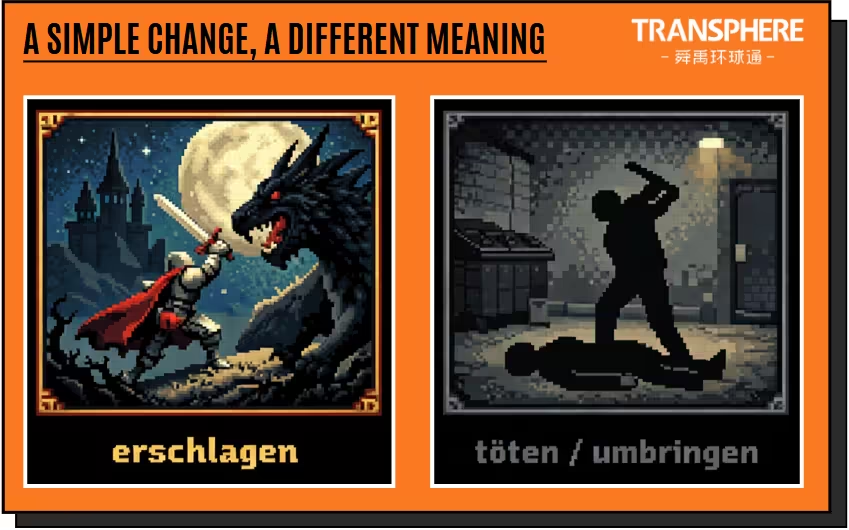
Narrative RPGs and adventure games need creative transcreation, the ability to adapt humor, wordplay, and cultural references rather than translate them literally. When localizing Slay the Princess into German, the translation team chose “erschlagen” for “slay” (a word commonly used in fairy tales for killing mythical creatures) rather than a generic equivalent, preserving the game’s narrative tone.
Mobile and casual games need concise, UI-focused translation where every character counts. A “Save” button that becomes “Speichern” in German (9 characters vs. 4) can break your layout if you haven’t planned for it.
Multiplayer and competitive games need translators familiar with real-time communication norms and community terminology that players already use in the target language.
Wherever possible, give translators access to a playable build of the game. The investment in time pays for itself in reduced queries, fewer errors, and translations that actually capture the experience of playing.
7. Culturalize, don't just translate
Localization goes beyond language. Culturalization means adapting content so it resonates (or at least doesn’t offend) across different cultural contexts.
Symbols and imagery require careful review. Germany heavily regulates the display of symbols like the swastika, while a 2018 rule change now permits their use in games with artistic or educational merit, most developers still avoid them entirely to prevent rating complications. Skulls and skeletons face restrictions in the Chinese market. Hand gestures that are innocent in one culture can be deeply offensive in another.
Flags are not languages. Using the French flag to represent the French language excludes French speakers in Canada, Belgium, Switzerland, and over 20 African countries. Use language locale codes (fr-FR, fr-CA, pt-BR) instead.
Age ratings vary by region. PEGI (Europe), ESRB (North America), and CERO (Japan) each have different thresholds for violence, sexual content, and gambling mechanics. Japan’s CERO even applies different standards depending on whether the game is on PC or console.
Stay current with regional regulation. In March 2025, the EU’s Consumer Protection Cooperation Network published seven key principles on in-game virtual currencies, requiring that all in-game purchase prices be clearly displayed in real-world money — not just virtual currency. While these principles are non-binding, the CPC Network has already taken enforcement action against at least one studio, and additional regulation through the forthcoming Digital Fairness Act is anticipated. If you sell in the EU, audit your monetization UI for compliance.
8. Use AI and machine translation strategically
Machine translation has improved enormously, and any modern guide to game localization best practices has to address it honestly. Ignoring MT entirely is leaving efficiency on the table. But using it as a replacement for human translators is a recipe for embarrassment.
Where MT works well: repetitive UI strings, system messages, patch notes, and large volumes of low-creative-density text. Modern MT post-editing (MTPE) workflows (where a machine generates the first draft and a human translator refines it) can cut turnaround times significantly for these content types.
Where MT falls short: narrative dialogue, humor, culturally sensitive content, and anything requiring creative adaptation. These still need human translators with full context and creative freedom.
AI-assisted QA is a genuinely useful middle ground. Automated tools can flag truncated strings, missing translations, inconsistent terminology, and formatting errors far faster than manual review. Use them as a first pass before your human LQA team does their contextual review.
The post-production stage of game localization
Even studios that follow every best practice for game localization during development can stumble at the finish line. The post-production phase is where you prove your localization actually works inside the game, and where you extend it beyond the game itself.
9. Test localized builds in context, not on spreadsheets
Linguistic quality assurance (LQA) conducted entirely in a spreadsheet catches typos but misses everything that actually matters to players: truncated text that overflows a dialogue box, a translated button that overlaps an icon, a joke that doesn’t land because the translator didn’t know it was meant to be funny, or a culturally jarring image that slipped through.
Test inside the game build. Run every localized version through the same QA scenarios you run for your base language. Check platform-specific compliance, Sony’s TRC and Microsoft’s TCR requirements include localization-specific checks that can block certification if failed.
Consider pseudolocalization as an early smoke test during development. Pseudolocalization replaces English strings with accented, elongated versions (e.g., “[Ţĥîš îš å ţëšţ šţŗîñĝ!!!!!]”) so you can spot UI overflow, hardcoded strings, and concatenation issues before any real translation begins. It costs nothing and catches problems months earlier than real LQA.
10. Localize your store presence, not just your game
A perfectly localized game behind an English-only store page is invisible to non-English audiences. Steam’s discovery algorithm favors games that support a user’s language, both in search results and in curated recommendations. App Store and Google Play work similarly.
Localize your store page title and description, your screenshots (swap in localized UI captures), your trailers (add subtitles or localized voiceover), and your tags and keywords. Translate your community hub posts and patch notes.
This is also where your marketing localization needs to start early. If you’re building pre-release hype with trailers and social media, do it in your target languages from the beginning, not as an afterthought after launch.
Key takeaways
Game localization is not a post-production task you bolt on at the end. It’s a development discipline that starts at code architecture, runs through production, and extends into your live marketing and store presence.
The best practices for game localization outlined above share a common thread: the earlier you plan for global players, the less it costs and the better it works. Studios that internalize this don’t just avoid localization disasters, they capture revenue that their competitors leave behind.
FAQ
There's no universal answer. It depends on your platform and business model. For PC games on Steam, Simplified Chinese is essential (it's the platform's most-used language), followed by Japanese, Korean, German, Russian, and Brazilian Portuguese. For console, prioritize Japanese, German, French, and Spanish.
For mobile, Japanese and Korean offer the highest ARPU with fewer barriers than China, while Brazilian Portuguese and Southeast Asian languages are strong growth markets. In all cases, let revenue data and your genre's audience guide the decision rather than defaulting to the traditional FIGS set.
Translation converts text from one language to another. Localization adapts the entire player experience (UI layout, cultural references, date and currency formats, imagery, audio, and legal compliance) so the game feels native to each target market.
At the beginning of development. Internationalize your code, design flexible UI, and establish your localization kit during pre-production. Retrofitting localization into a finished game is significantly more expensive and error-prone
Costs vary dramatically based on word count, number of languages, whether voice-over is included, and the level of culturalization required. A text-only localization for a small indie game into FIGS might run a few thousand dollars; a full AAA localization with VO into 15+ languages can cost hundreds of thousands.
For a detailed breakdown, consider reading our game localization cost analysis.